2023 Season Report

The 2023 season of the Michigan State University Excavations at Isthmia, which began on 16 May and concluded on 29 July, was devoted to improvements to the study and storage facilities as well as ongoing research, digitization and documentation projects.

  • The 2023 team consisted of the following individuals:
    • Jon M. Frey: director
    • Lita Tzortzopoulou-Gregory: assistant director
    • William Caraher: archaeologist
    • Rebecca Casement: ceramic artist
    • Christian Cloke: digital technologist
    • Panayoti Diacopoulos: photographer
    • Drosos Kardulias: archaeologist
    • Nick Kardulias: archaeologist
    • Kostis Kourelis: archaeologist
    • Ulrike Krotscheck: archaeologist
    • Sarah McLean: social media specialist
    • Allison Miller: social media specialist
    • Scott Moore: archaeologist
    • Scott Nash: archaeologist
    • David Pettegrew: archaeologist
    • Richard Rothaus: archaeologist
    • Albert Sarvis: GIS specialist
    • Daniel Trego: photographer
  • The 2023 MSU Undergraduate Study Abroad students were:
    • Session I
      • Rashad Bates
      • Vicky Chen
      • Logan Petty
      • Kailey Reed
      • Rebecca Sun
      • Sydney Urbaniak
    • Session II
      • Emma Borowski
      • Julia Egber
      • Nahom Ghebredngl
      • Christi Lopez
      • Morgan Manuszak
      • Ally Miscikoski
      • Marissa Rubaiai
      • Mackenzie Sheehan-D’Arrigo
      • Liz Vadella
      • Megan Weaver

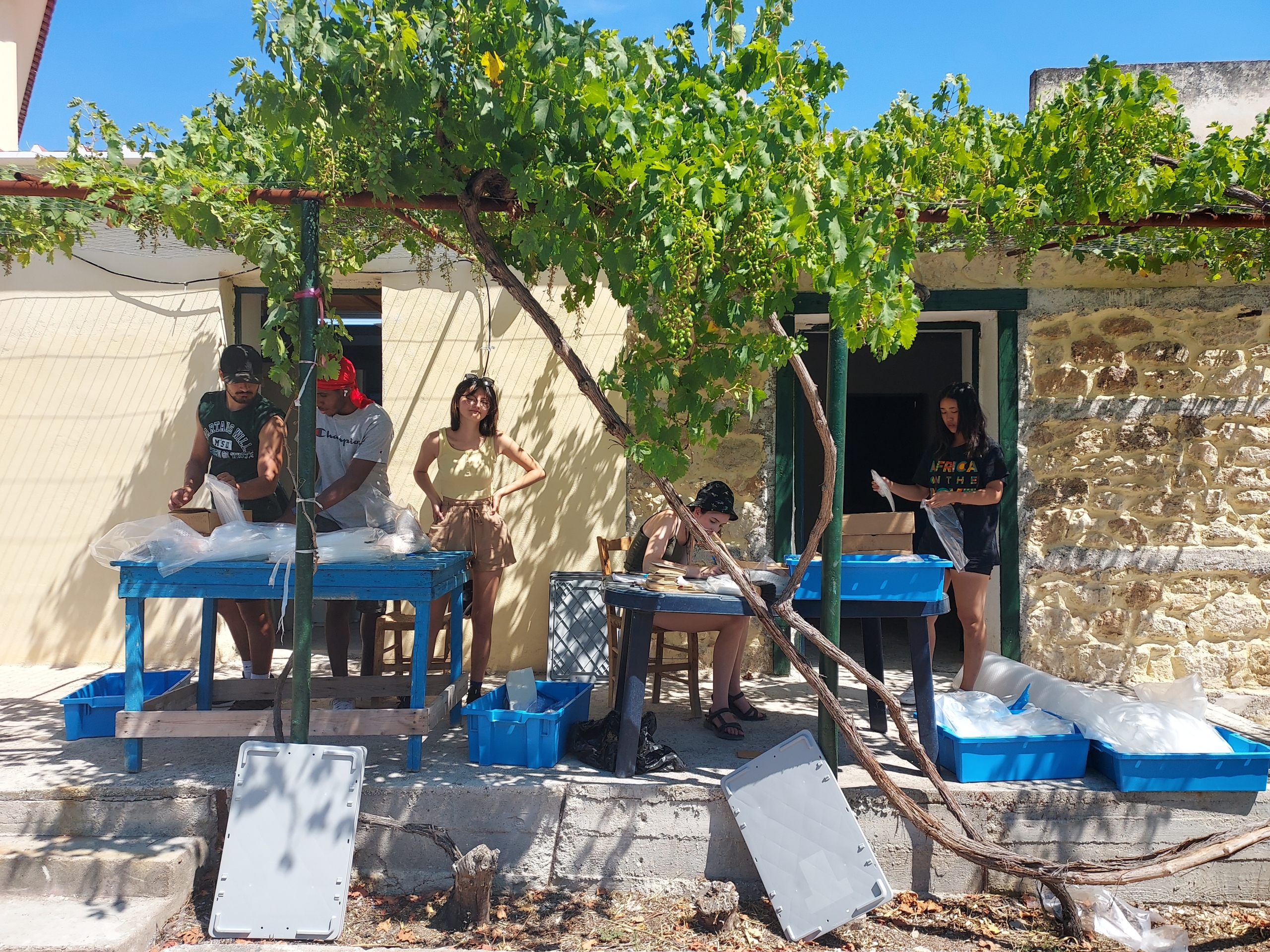
MSU Students from the May/June program help with reorganizing the storerooms.

Studying a lamp from the MSU Isthmia collection.

Painting a mural inside the excavation house.

This year the project engaged in the following activities.

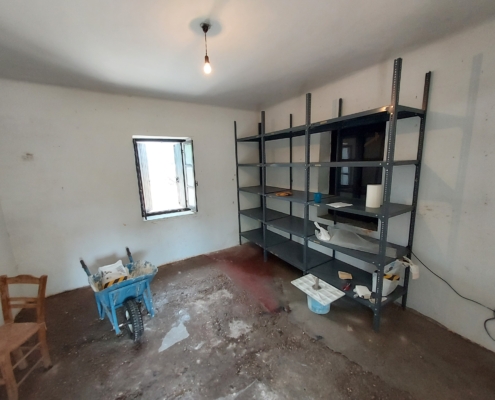
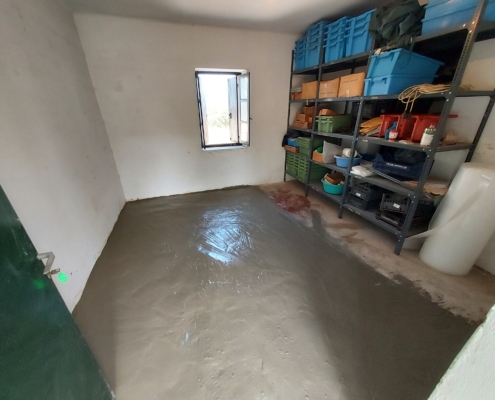
Improved storage: As a result of the construction of a new storage room for the material from the excavations at Kenchreae, access to the storage room traditionally known as the “architekteion” was returned to the MSU Excavations. Over the course of this season, this older storage room was cleared of debris and the floor leveled in preparation for the installation of metal shelving for storage. We anticipate completing this process in 2024 and shifting material from the semi-outdoor storage area to the architekteion.

Clearing out the “architekteion.”

Leveling the floor of the storage space.

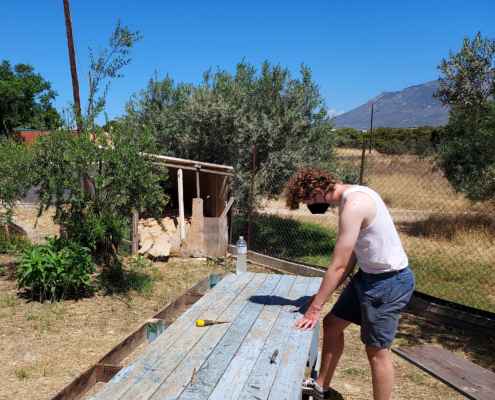
Wooden shed for pottery in background.

Area after removal of wooden shed.

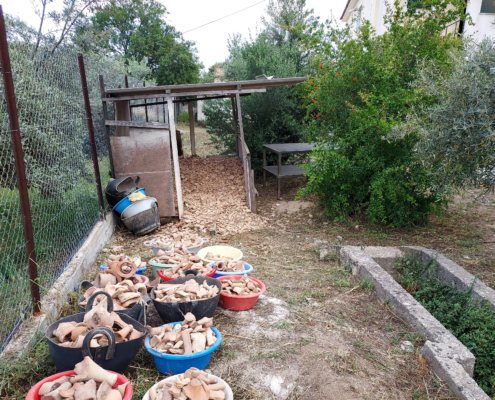
Pottery from the wooden shed.

Barrels holding diagnostic pottery.

The “Pottery Shed”:

The construction of a large concrete pad for the storage shed for the Cenchreae material also presented an opportunity to respond to a request from the ephoreia to remove a large pile of discarded pottery from the 1970s excavations in the Roman Bath and East Field.  This mass of ceramic material, which is now associated with the sorting practices of the UCLA excavations, was re-discovered in the 1990s in a location to the northwest of the Temple temenos and after study, was redeposited in a makeshift wooden shed on the grounds of the OSU Excavations. This season, the shed, which had long since collapsed was demolished. Of the pottery stored within, all diagnostic pieces were retained, while all non-diagnostic sherds were used to fill a previously excavated trench located to the northeast of the Roman Bath (Trench 78-14 and Trench 2010-03), that had become a hazard for visitors to this area of the site.  All diagnostic sherds are now stored in five large plastic barrels just to the northwest of the Kenchreae storage shed. As a result both the grounds of the MSU Excavations study center and the area of the Roman Bath are safer, cleaner and less visually distracting than in the past.

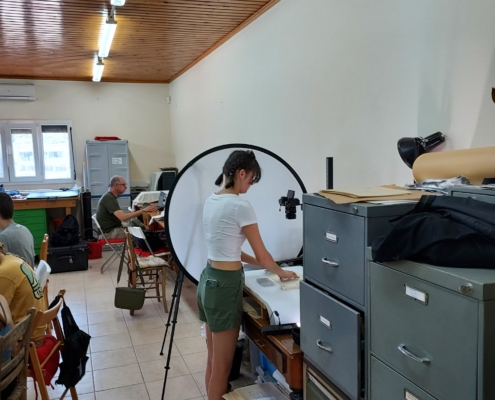
Digitization: This season, the Isthmia team also completed the photographic documentation of all catalogued ceramic material in storage in the first floor of the area traditionally known as the “dig house.”  This brings to completion a process begun in 2021 so that now over 1300 photographs have been made available online at https://inventoriedobjects.s3.amazonaws.com/index.html This process, which also serves as an informal shelf audit, has now moved to the documentation of all catalogued sculpture in the storage at the MSU Excavations.

The digitization of archaeological documentation from the 1967-2004 seasons also continued this summer.  In particular, the digitization of all color slides was completed, along with all the traditional line drawings of cataloged objects.  At present, only the black and white photographic negatives, the hand-written photography logbooks and a variety of typewritten reports remain to be digitized.  It is expected that the complete digitization of all forms of archaeological documentation will be completed by the end of the 2024 season. Unfortunately, due to a lack of technological support, the Archaeological Resource Cataloging System (ARCS), which was intended to serve as the central repository for these digitized records, has been deprecated and is now considered non-functional.  At present, we are attempting to develop a new solution for the presentation of these digitized archival records.

Photographing line drawings.

Ceramic evidence from a West Cemetery grave.

West Cemetery: Study of the West Cemetery, which began in 2022, continued this season as well.  As was the case last season, research this year concentrated on locating and organizing all cataloged objects, along with their associated archaeological records. The goal is to place all of the finds from the Lambrou Cemetery and Filis Field into assemblages associated with the specific graves from which they originated. The goal is to publish a study of the osteological material in conjunction with the material evidence of the burials.

Site maintenance: Lastly, as occurs each season, the Roman Bath was cleaned of the vegetation and debris that accumulates each season, especially in Rooms III/IV/V and Room IX where the floor is preserved at a lower level.  Damage to the structure from exposure to the elements is increasingly evident, especially in the case of the hypocausts of Room IX and the restored mosaic of Room VI. This makes our collaboration with Miltos Katsaros of the Athens Polytechnic University to develop a plan for a covering over the entire bath structure even more important.

Students cleaning the Roman Bath.