
The 2024 season of the Michigan State University Excavations at Isthmia was dedicated to a number of different initiatives intended to improve both our understanding of the site and access to evidence of its archaeological past.
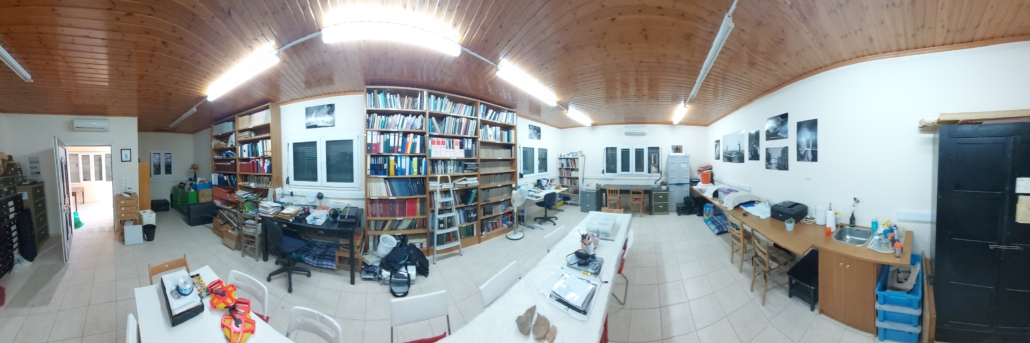
The upper floor of the Isthmia “Dig House” following a rearrangement of the workspace.
- The 2024 team consisted of the following individuals:
- Jon Frey (Michigan State University): Director
- Lita Gregory (Australian Archaeological Institute at Athens): Assistant Director
- Michael Arvanitis (University of Patras): Geospatial Survey Specialist
- Jeff Batcher (Mercer University): Archaeologist
- William Caraher (University of North Dakota): Archaeologist
- Rebecca Casement (Michigan State University): Ceramics Specialist
- Panoyoti Diacopoulos (CCAD): Photographer
- P. Nick Kardulias (College of Wooster): Archaeologist
- Drosos Kardulias (University of Michigan): Undergraduate Archaeology Student
- Noah Kaye (Michigan State University): Archaeologist
- Kostis Kourelis (Franklin and Marshall College): Archaeologist
- Ulrike Krotscheck (Evergreen State College): Archaeologist
- Gunhee Lee (Seoul National University): Archaeology Student
- Morgan Manuszak (Michigan State University): Archaeologist
- R Scott Moore (Indianna University of Pennsylvania): Archaeologist
- Olivia Morea (Michigan State University): Archivist
- Scott Nash (Mercer University): Archaeologist
- Elpida Ntriva (University of Patras): Undergraduate Archaeology Student
- Iro Paschali (University of Peloponnese): Undergraduate Archaeology Student
- David Pettegrew (Messiah College): Archaeologist
- Richard Rothaus (Central Michigan University): Archaeologist
- Rebecca Sun (Michigan State University): Archivist
- Daniel Trego (Michigan State University): Photographer / Archivist
- Carol Verboncoeur (Michigan State University): Archivist
- The 2024 MSU Undergraduate Study Abroad students were:
- Session I
- Liam Bordoni
- Grace DeJohn
- Megan Gleason
- Jordan Gurka
- August James
- Mia Kunath
- Frank Staub
- Session II
- Veronica Borruso
- Vanesa Fernandez
- Paulette Gutierrez
- Avery Horejsi
- Gabriel Jones
- Jillian Moreno
- Shaylyn Sprague
- Hunter Thomas
- Session I
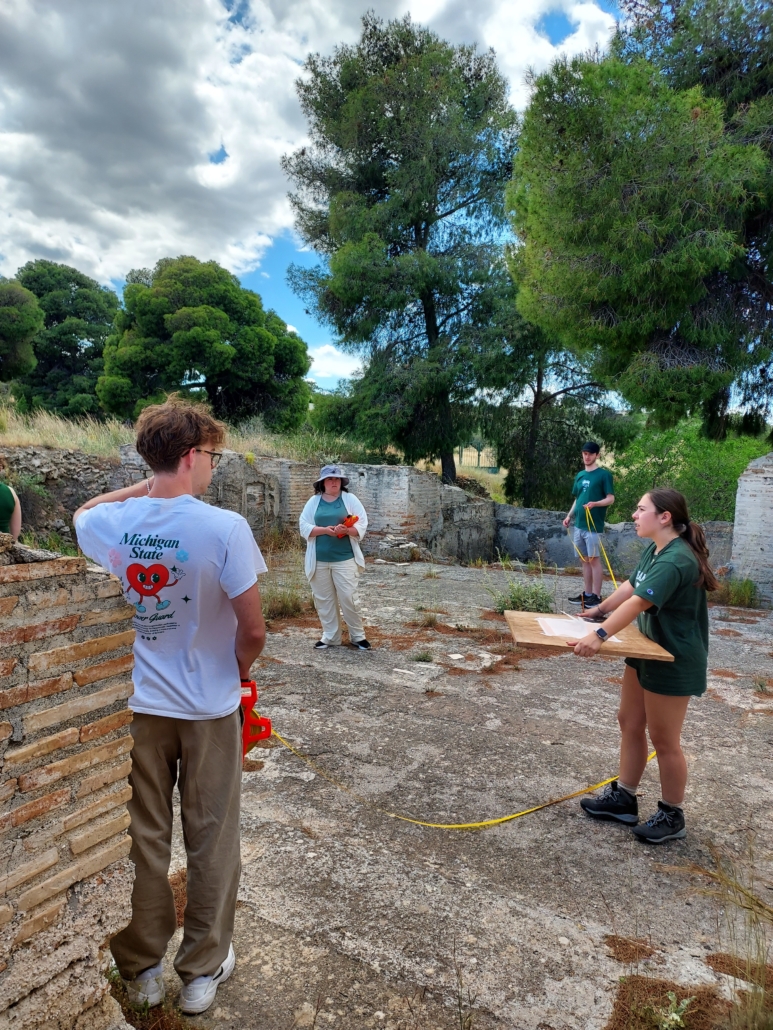
Students on the Design and Archaeology Program take measurements in the Roman Bath.
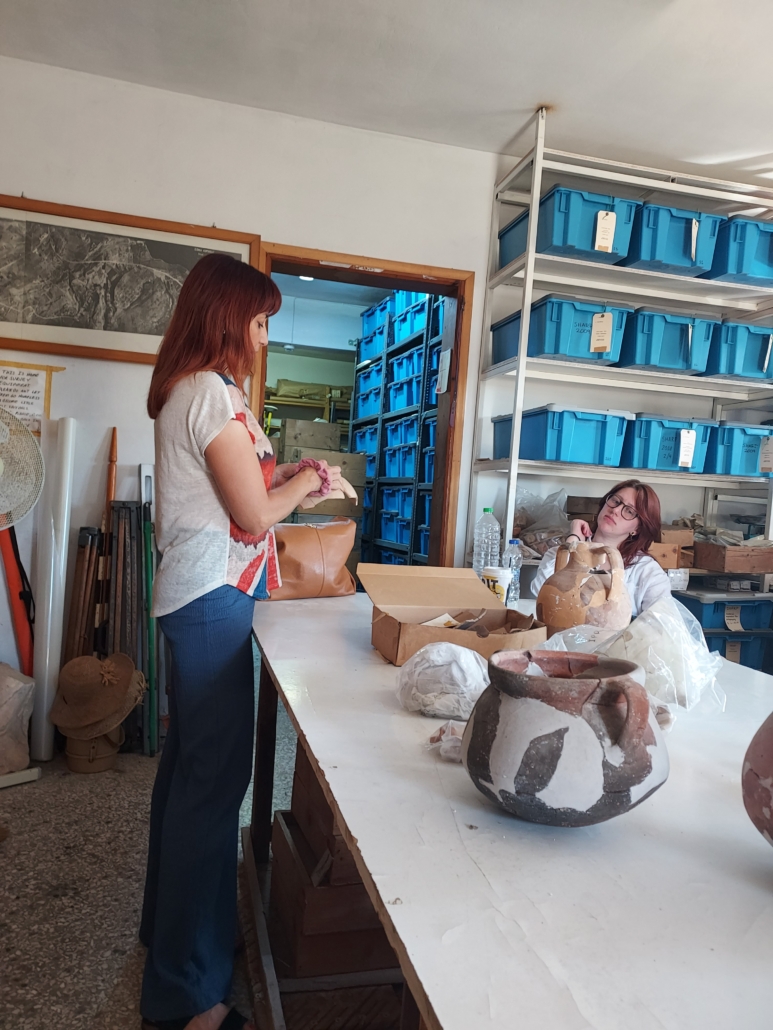
Conservator Angeliki Kandri gives students on the Ceramics in Greece Program an introduction to the art and science of mending pottery.
This season was the first of two for which we have received a permit from the Greek Ministry of Culture for fieldwork. The intended goal for 2024 was to engage in a collaborative project with the University of Chicago / Notre Dame Excavations and Dr. Michael Arvanitis, a geophysical specialist, to survey various parts of the site and surrounding region. Unfortunately, this effort was hindered by an inability to secure the necessary permissions from the local property owners so that much less survey was carried out than had been proposed.
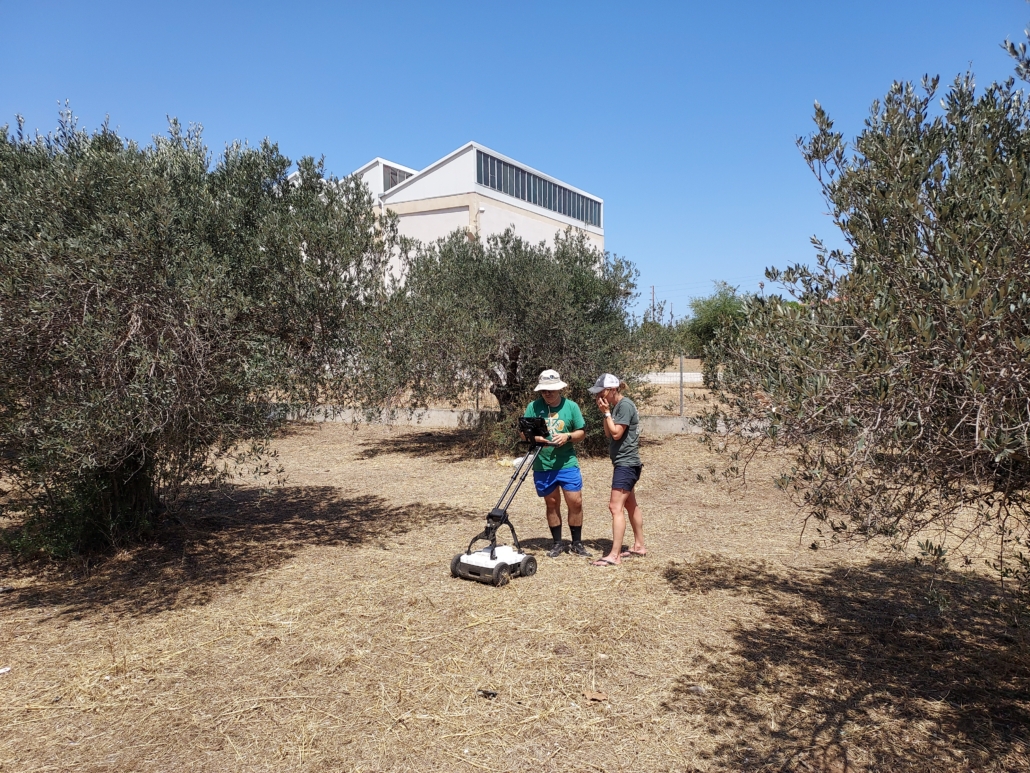
Geophysical Specialist Michael Arvanitis and Ulrike Krotscheck begin a survey of the area south of the West Cemetery.
Survey of a small plot of land at the intersection of the road to New Corinth and the road to Hexamilia, located 0.7 km southwest of the museum revealed no less than five distinct anomalies, which may represent graves at the out limits of the area excavated in 1968-1970 as the West Cemetery. More extensive survey in the area to the east of the temple temenos, in the area known as the East Field, showed a cluster of structures, resembling the remains of walls that meet at right angles along E-W and N-S axes, indicating a possible presence of rooms. These structures are evident at 1.15m below the surface, which seems to corelate well with the excavated features in this area. The absence of other features at a similar depth to the north and south of these anomalies may be due to the presence of routes of passage through the site in the area to the south of the cavea of the theater. Finally, survey to the south and east of the Roman bath also yielded indicators suggestive of buried architectural features. To the south of the eastern rooms of the bath anomalies that are oriented north-south and east-west may represent the eastern continuation of a possible courtyard that is known on its western and southern sides. More intriguing still, exploration of the area to the east of Rooms VII and XII revealed an unexpectedly dense cluster of anomalies that cannot be explained at the present moment. This will likely be the location of limited excavation to take place next season.
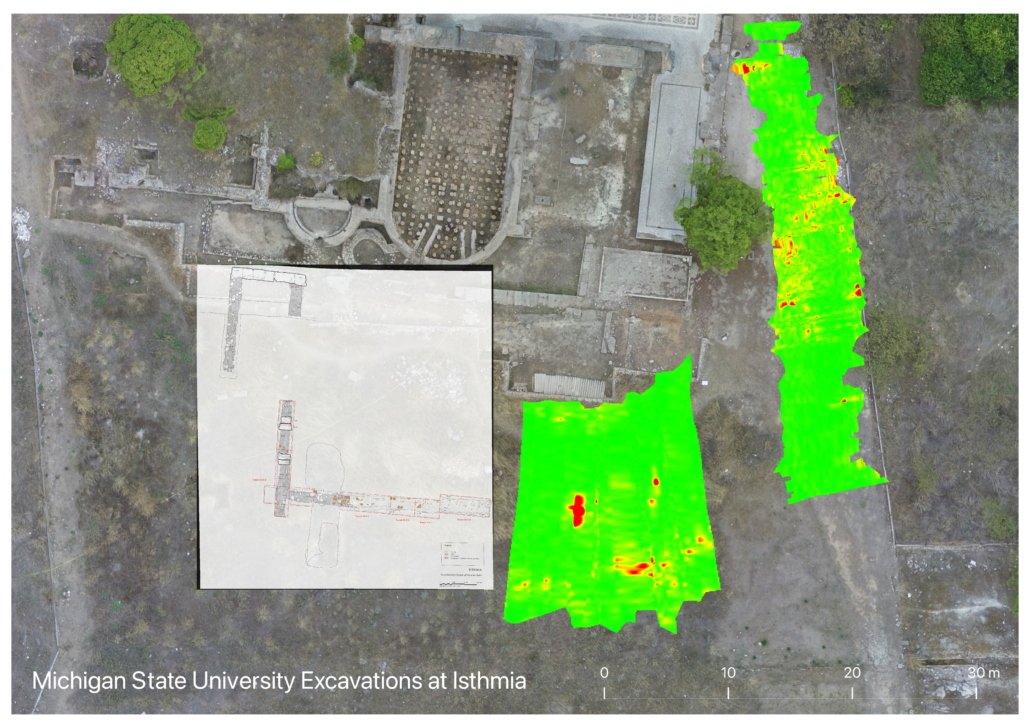
Aerial view overlaid with a plan of the walls south of the Roman Bath and the results of the 2024 geophysical survey.
During this season the MSU Isthmia team also completed the first phase of an NEH-funded project to improve the storage and retrieval system for records and artifacts. This involved two concurrent activities. On the one hand a more efficient metal shelving system was installed in the storeroom that had been returned to project control the previous season. On the other hand, a Radio Frequency Identification (RFID) system was implemented for objects held in storage.
This involved a collaboration with the Athens-based Zeus RFID company, which provided the RFID tags, reader and web-based inventory control software solution. As an initial test of the system, each of the more than 200 field notebooks and close to 800 discrete collections of context pottery were assigned unique RFID tags that were written into the associated software. Then using a hand-held scanner, we were able to conduct an almost instantaneous audit of all tagged items. What is more, notebooks and collections of pottery that were intentionally misplaced for the purposes of this test were quickly identified and located using the system’s “locator” function. Overall, this initial implementation of the system was a success and we look forward to developing a solution for individually cataloged artifacts next season.
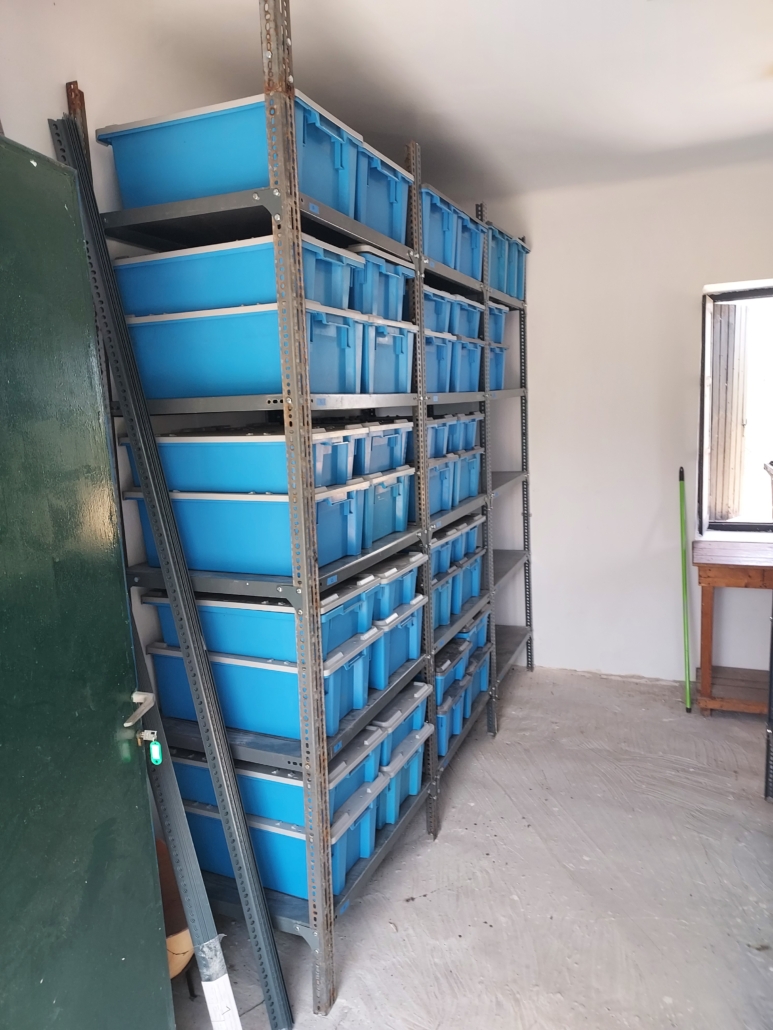
Newly installed shelves and bins containing context pottery from the 1990s excavations.
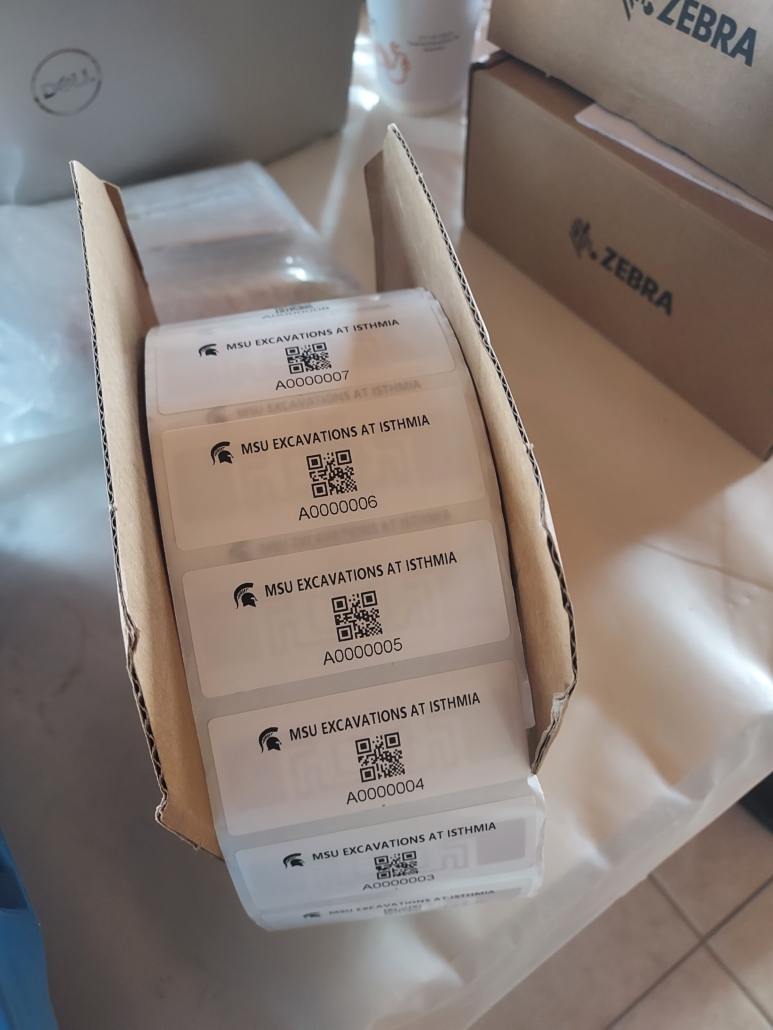
RFID tags ready for use in tracking artifacts at Isthmia.
In addition to these new initiatives, other, longer-lasting projects continued this year. Thus work continued on compiling the available written and material evidence from the excavation of the West Cemetery and the Roman Bath, which we expect to be published in the near future. Likewise, the MSU Isthmia team continued the long process of digitizing records and documents in the UCLA and OSU archives. This season, particular attention was given to the large number of line drawings of ceramic profiles and other artifacts. Because many of the drawings are larger than the area of the scanner, we have begun using a digital SLR camera to create a digital copy of these records. This technique has proven successful and will be used in future seasons to digitize typewritten reports from the 1960s and 1970s.
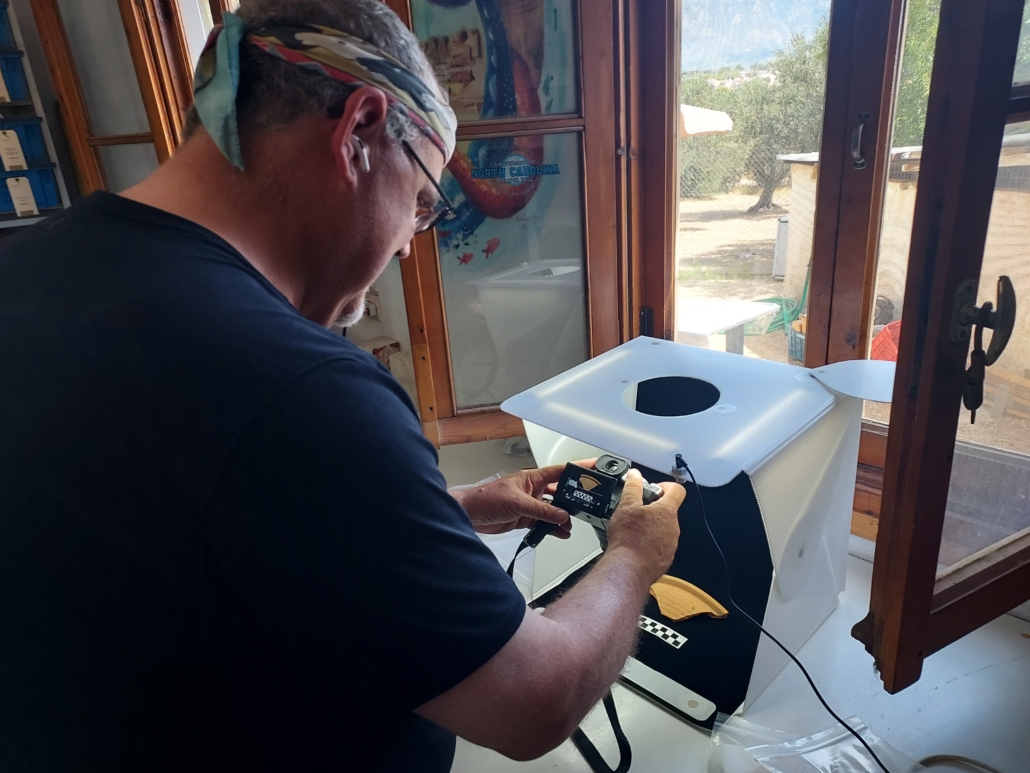
Richard Rothaus photographing artifacts.
Finally, in keeping with its educational and outreach mission, the MSU Excavations also hosted several tour groups and two longer-term student study programs. The first, Design and Archaeology in Greece, focused on the archaeologists work from the point of view of graphic and user experience designers. The second focused on ceramics as an object of archaeological interest, but also artistic expression. Both programs were very successful and point to the benefit of collaborations that go beyond the traditional limits of archaeological fieldwork.
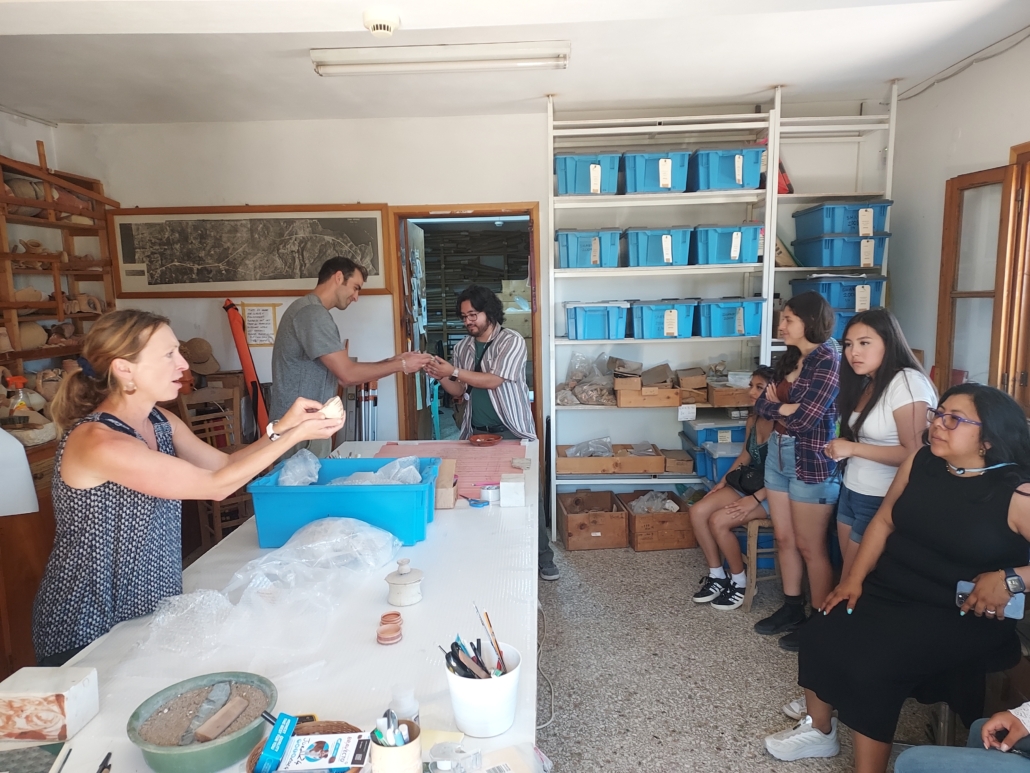
Ulrike Krotscheck sharing the results of her ongoing study of the West Cemetery with a group of high school students from Los Angeles.
As we look to the future, we anticipate a productive 2025 season, both in our plans to engage in limited excavation, and in our continuing effort to conserve and protect the monuments, artifacts and records generated over the long history of work at the site.